
The physics of air cooling impose hard limits. Air has a volumetric heat capacity approximately 3,500 times lower than water. As rack power densities increase beyond 15–20 kW, air cooling requires exponentially more fan power, larger plenum spaces, and increasingly complex containment - eventually reaching a point where air simply cannot remove heat fast enough to prevent thermal throttling.
This is not a theoretical concern. Indian data centers supporting AI workloads, GPU clusters, and high-performance computing are already encountering these limits. A single modern GPU server can draw 6–10 kW - three to five such servers in a rack create a 30–50 kW thermal load that no air cooling system can handle efficiently.
Understanding the Cooling Options
Traditional Air Cooling (CRAC/CRAH)
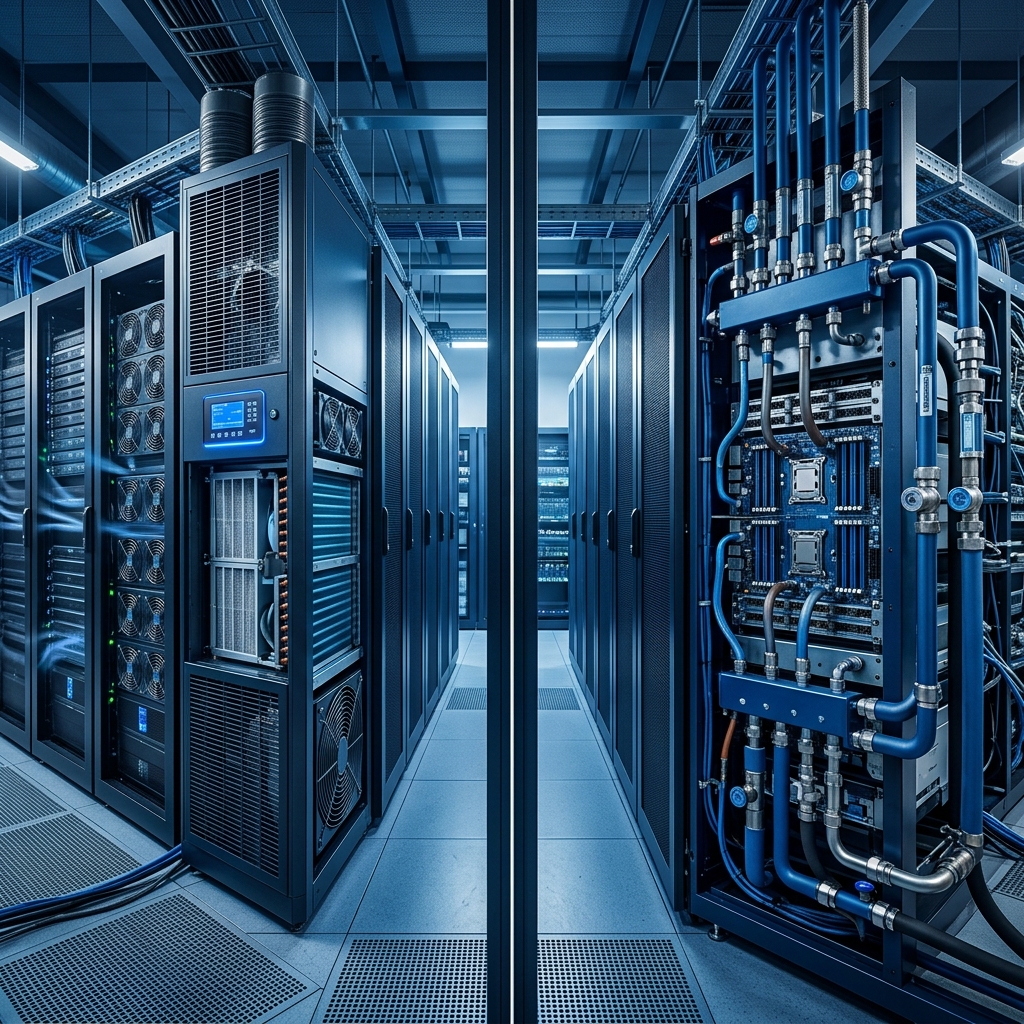
The dominant cooling method in Indian data centers. Computer Room Air Conditioning (CRAC) or Computer Room Air Handling (CRAH) units circulate chilled air through the facility, typically via raised floor plenums. Effective for rack densities up to 8–10 kW. Beyond this, air cooling requires containment, supplemental in-row cooling, and increasingly powerful fans - all of which consume significant energy. Typical PUE contribution of air cooling alone: 0.3–0.6 (meaning 30–60% of IT power load is consumed by cooling).
In-Row and Rear-Door Cooling
A hybrid approach that places cooling units directly adjacent to or behind the racks. Rear-door heat exchangers use chilled water coils to remove heat as exhaust air passes through them. Effective for rack densities up to 20–25 kW. Lower energy consumption than traditional CRAC because cooling happens at the point of heat generation, reducing the need for high-velocity air distribution. This is the most practical upgrade path for existing Indian facilities seeking to support moderate high-density workloads.
Direct-to-Chip Liquid Cooling
Cold plates are mounted directly on CPUs and GPUs, with liquid (typically water or specialised coolant) circulated through them. The liquid absorbs heat directly from the hottest components, then transfers it to a facility cooling loop. Direct-to-chip cooling can handle rack densities of 50–100+ kW while using 30–50% less energy than air cooling for the same heat load. This is the preferred approach for AI/GPU-heavy workloads where the highest-power components are the processors themselves.
Immersion Cooling
Entire servers are submerged in a non-conductive dielectric fluid. The fluid absorbs heat from all components simultaneously. Single-phase immersion uses fluid that remains liquid; two-phase immersion uses fluid that boils at a low temperature, with the vapour condensing on a heat exchanger above. Immersion cooling eliminates the need for fans entirely, can handle extreme densities (200+ kW per rack), and reduces cooling energy by 90–95% compared to air cooling. However, it requires specialised server hardware, different maintenance procedures, and higher upfront infrastructure investment.
Cost Comparison for Indian Deployments
Infrastructure cost per kW of IT capacity: Air cooling (CRAC): ₹15,000–25,000 per kW, mature supply chain, widely available in India. In-row/rear-door: ₹25,000–40,000 per kW, growing availability from Indian and international vendors. Direct-to-chip: ₹40,000–70,000 per kW, limited Indian supply chain, typically sourced internationally. Immersion: ₹60,000–1,20,000 per kW, very limited availability, highest upfront cost but lowest operating cost.
However, infrastructure cost is only part of the equation. Operating cost per kW-year tells the real story: Air cooling at PUE 1.6: approximately ₹90,000–1,10,000 per kW-year in power costs. Liquid cooling at effective PUE 1.1: approximately ₹62,000–70,000 per kW-year. The annual savings of ₹25,000–40,000 per kW translate to ₹25–40 lakh per MW per year. Over a 10-year facility life, this more than compensates for the higher infrastructure cost.
Decision Framework: When to Switch
Stay with air cooling if: your average rack density is below 10 kW, you have no GPU or AI workloads planned, and your facility has adequate space for containment and CRAH units. Consider rear-door/in-row if: rack densities are 10–25 kW, you are retrofitting an existing air-cooled facility, and you want a proven, moderate-cost upgrade. Consider direct-to-chip if: rack densities exceed 25 kW, GPU/AI workloads are a significant portion of your compute, and you are building a new facility or major expansion. Consider immersion only if: you are building a purpose-designed facility for extreme-density compute, have specialised operational expertise, and can absorb the higher upfront investment.
India-Specific Considerations
India's tropical climate makes the cooling decision more impactful than in cooler regions. Facilities in cities like Chennai and Mumbai, where ambient temperatures exceed 30°C for most of the year, gain disproportionate benefit from liquid cooling because air-based free cooling opportunities are limited. Conversely, facilities in Pune or Bangalore with more moderate climates can extract significant value from air-side economisation before needing to invest in liquid cooling.