
India's data center industry is in the midst of its most significant expansion in history. The confluence of cloud migration, artificial intelligence workloads, government data localisation mandates, and the Digital India initiative has created a demand environment that shows no sign of slowing. For investors, operators, and enterprises, understanding the contours of this market is essential to making informed decisions.
Market Size and Growth Trajectory
India's operational data center capacity crossed 1,100 MW in 2025 and is projected to reach 2,500–3,000 MW by 2028. This represents a compound annual growth rate exceeding 25% - making India one of the fastest-growing DC markets globally, behind only the United States and China in absolute capacity addition.
The growth is not uniform. Hyperscale deployments account for over 40% of new capacity, driven by AWS, Microsoft Azure, Google Cloud, and Oracle expanding their India regions. Colocation demand from Indian enterprises - particularly in BFSI, e-commerce, and healthcare - accounts for another 35%. The remaining 25% comes from enterprise-owned facilities and edge deployments.
Investment Hotspots: Where the Capacity Is Going
Tier-I Cities: Mumbai, Chennai, Hyderabad
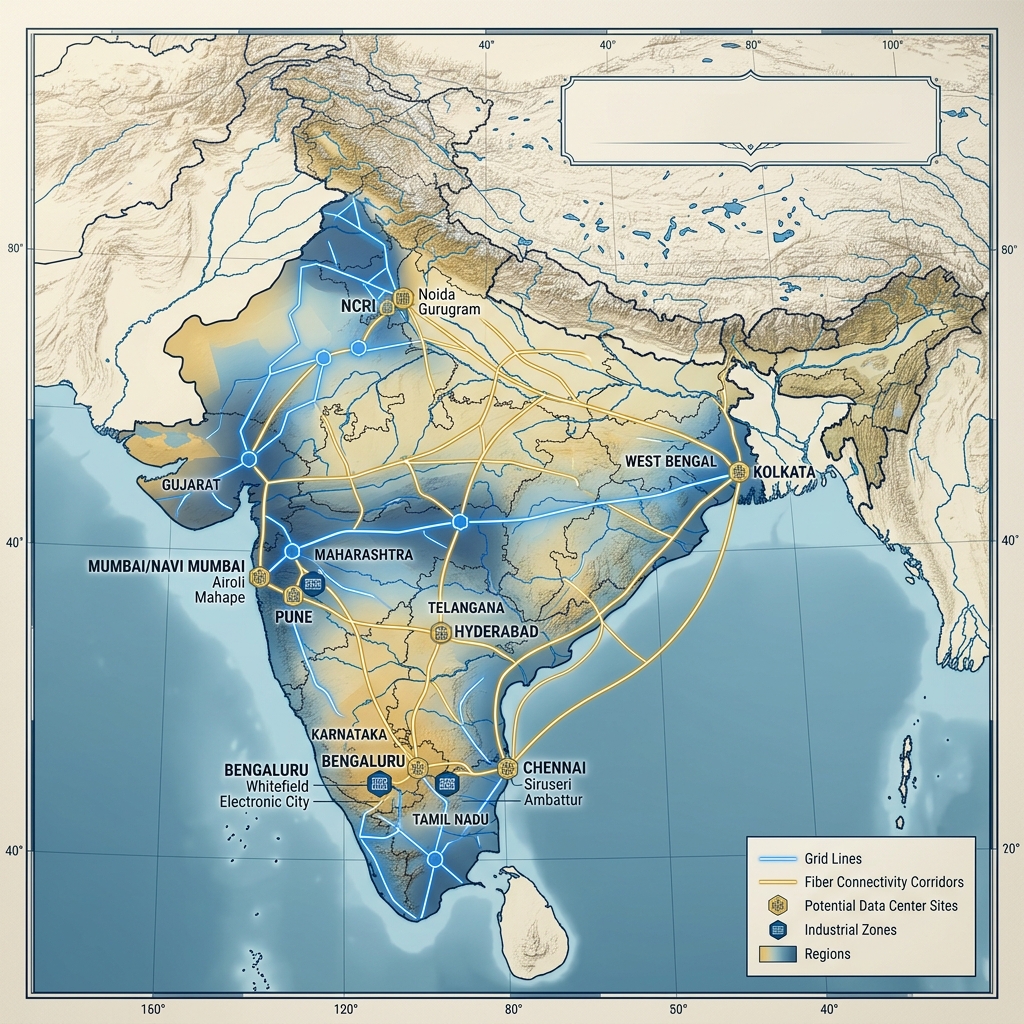
Mumbai remains India's largest DC market with over 400 MW of operational capacity and another 500+ MW under construction. Navi Mumbai and Panvel are emerging as the next expansion corridors due to land availability and new submarine cable landings. Chennai has become the submarine cable hub of India, making it the preferred location for international traffic-heavy workloads. Hyderabad's IT corridor and proactive state government incentives have attracted significant hyperscale investment.
Tier-II Cities: Pune, Kolkata, Noida
Pune is emerging as a viable DC market for enterprises seeking proximity to Mumbai without Mumbai land costs. Kolkata serves the under-penetrated eastern India market with growing BFSI demand. Noida and Greater Noida benefit from proximity to Delhi's enterprise base with significantly lower land and power costs.
Emerging: Vizag, Kochi, Coimbatore
The next wave of DC development will likely include cities with strong fibre connectivity, stable power supply, and state government incentives. Visakhapatnam, Kochi, and Coimbatore are all positioning themselves as DC-friendly destinations.
Key Demand Drivers
Five forces are driving India's DC growth simultaneously. First, the Reserve Bank of India's data localisation requirements for financial data force BFSI workloads to remain in-country. Second, AI and ML workload growth is creating demand for high-density compute infrastructure that existing facilities are not designed to support. Third, the Digital India initiative and increasing digitisation of government services require massive storage and compute capacity. Fourth, the growth of Indian SaaS companies - India now has over 30 SaaS unicorns - drives demand for reliable, scalable infrastructure. Fifth, the global supply chain diversification trend is bringing international operators to India as a hedge against concentration risk in other markets.
Challenges and Risk Factors
Despite the opportunity, several structural challenges remain. Power availability and reliability is the single largest constraint - particularly in cities where grid capacity has not kept pace with DC demand. Water availability for cooling is becoming a regulatory and environmental concern, particularly in water-stressed regions. Land acquisition remains complex and time-consuming, with prices in Tier-I cities making new builds increasingly capital-intensive. Finally, the talent gap in DC operations - particularly for modern AIOps and high-density cooling management - is widening.
The Consulting Imperative
The scale and speed of India's DC buildout creates significant execution risk. Projects that skip independent feasibility analysis, design review, and commissioning oversight face cost overruns averaging 20–40% and commissioning delays of 3–9 months. For investors deploying capital into this market, independent technical oversight is not an optional expense - it is a risk management requirement.
Whether you are evaluating an investment opportunity, planning a new facility, or expanding existing capacity, the quality of pre-investment technical diligence determines the quality of post-investment returns.